The Kalahari, the desert that is not one
Nine hundred thousand square kilometres of sand under grass, black-maned lions, salt lakes where zebras run and the oldest people in the world: the Kalahari, from Botswana.
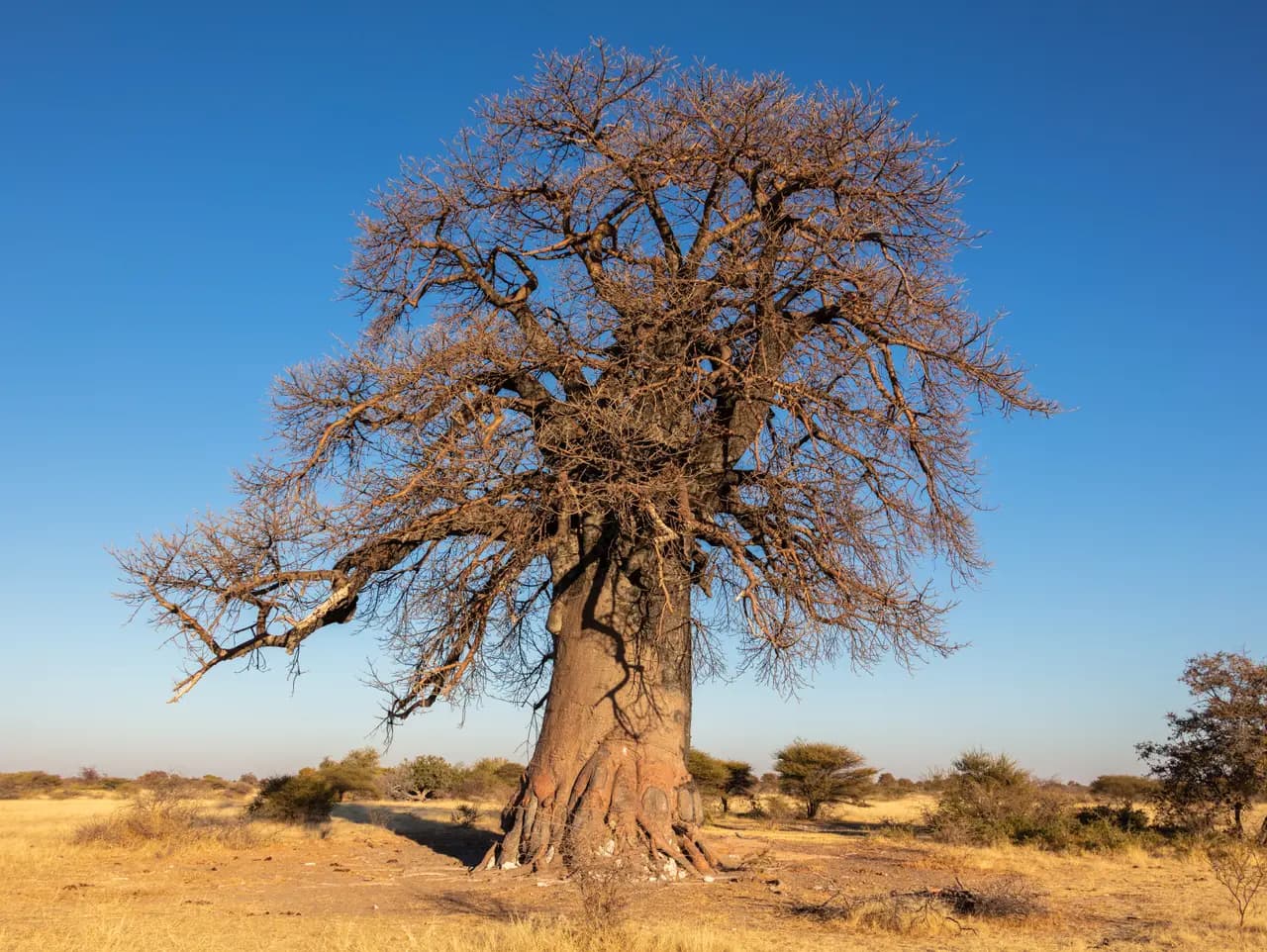
The Kalahari disappoints those who expect dunes. There is no sea of sand here, or almost none: there is grass, yellow to the horizon, flat-topped acacias, grey scrub, and beneath all of it, as deep as you care to dig, sand. Nine hundred thousand square kilometres of sand across Botswana, Namibia and South Africa, which drink the rain the moment it falls and leave no river at the surface. The Tswana named it Kgalagadi, ‘the place of thirst’. It is a desert by water, not by landscape.
And that is why it is alive. This notebook crosses it from Botswana, which holds the largest share: the Central Kalahari reserve and its Deception Valley, the Kgalagadi Transfrontier Park and its black-maned lions, the Makgadikgadi salt pans where zebras migrate and flamingos nest, the baobabs of Kubu, the painted hills of Tsodilo, then the people who have lived in all of this for tens of thousands of years, the San, and the delta that makes the desert a paradox.
A desert of grass and sand
The Kalahari receives between 150 and 500 millimetres of rain a year depending on the region, far more than the Namib or the Sahara. But the sand swallows everything: water sinks metres down, out of reach, and the surface stays dry nine months in twelve. Plants have learned to live with this, camelthorn acacias with roots forty metres long, the tsamma melon that stores water in its flesh, grasses that dry standing and feed the herds through the cold season.
Animals have done the same. The gemsbok may never drink; the springbok draws water from plants; the Kalahari lions, larger and paler than those of the north, with the black mane that makes them famous, roam immense territories to find their prey. Everything is more dispersed than elsewhere, and that changes how you look: you do not count animals, you search for them.
This sand is the floor of a very ancient basin, and it extends far beyond the desert proper, to the Congo and Angola. In central Botswana it carries the traces of fossil rivers, vanished lakes and old shorelines: the Kalahari is a landscape of geological memory, where you read the story of water that is no longer there.
The Central Kalahari and Deception Valley
The Central Kalahari Game Reserve, created in 1961, covers 52,800 square kilometres, more than the Netherlands, nearly a tenth of Botswana: it is the second largest game reserve in the world. You enter by tracks of deep sand, camp on unfenced sites hours apart, and can spend three days without meeting another vehicle.
Its heart is Deception Valley, the bed of a fossil river whose grass greens after the rains and then draws thousands of springbok, gemsbok and wildebeest, followed by their predators. Two American zoologists, Mark and Delia Owens, lived here for seven years in the 1970s, alone with the lions and brown hyenas, and drew from it a book, ‘Cry of the Kalahari’, that made the place known to the world.
The best season here is the reverse of the rest of southern Africa: from December to April, when it rains, the valleys are covered in short grass, antelopes gather, lions and cheetahs follow them, and the sky fills with spectacular storms. In the dry season the reserve empties and becomes a lesson in silence.
Kgalagadi: black-maned lions and red dunes
To the south-west, straddling the South African border, the Kgalagadi Transfrontier Park has united two older parks since 12 May 2000 in a single territory of 38,000 square kilometres, southern Africa’s first ‘peace park’. Here the Kalahari finally takes on its poster colours: red dunes covered in blond grass, and two dry riverbeds, the Nossob and the Auob, lined with acacias.
It is one of the best places on the continent to see the large predators without crowds: black-maned lions lying in the shade of the camelthorns, cheetahs on the ridges, leopards in the trees beside the waterholes, brown hyenas at dusk. The riverbeds concentrate animals around the boreholes, and you drive slowly from one waterhole to the next, watching the branches.
At night, Kgalagadi offers another spectacle. The !Ae!Hai Heritage Park, enclosed within its South African section, has been recognised as the first International Dark Sky Sanctuary in Africa: without a light for hundreds of kilometres, the Milky Way casts a shadow, and the camps light nothing but the fire.
Makgadikgadi: salt, zebras and flamingos
To the north-east, the Kalahari turns white. The Makgadikgadi pans are what remains of an immense lake, larger than Switzerland, dry for tens of thousands of years: a cracked crust of salt and clay, flat as a table, among the largest salt flats in the world. In the dry season you drive across it for kilometres without a landmark, in a white that merges with the sky, and mirages distort anything that stands up.
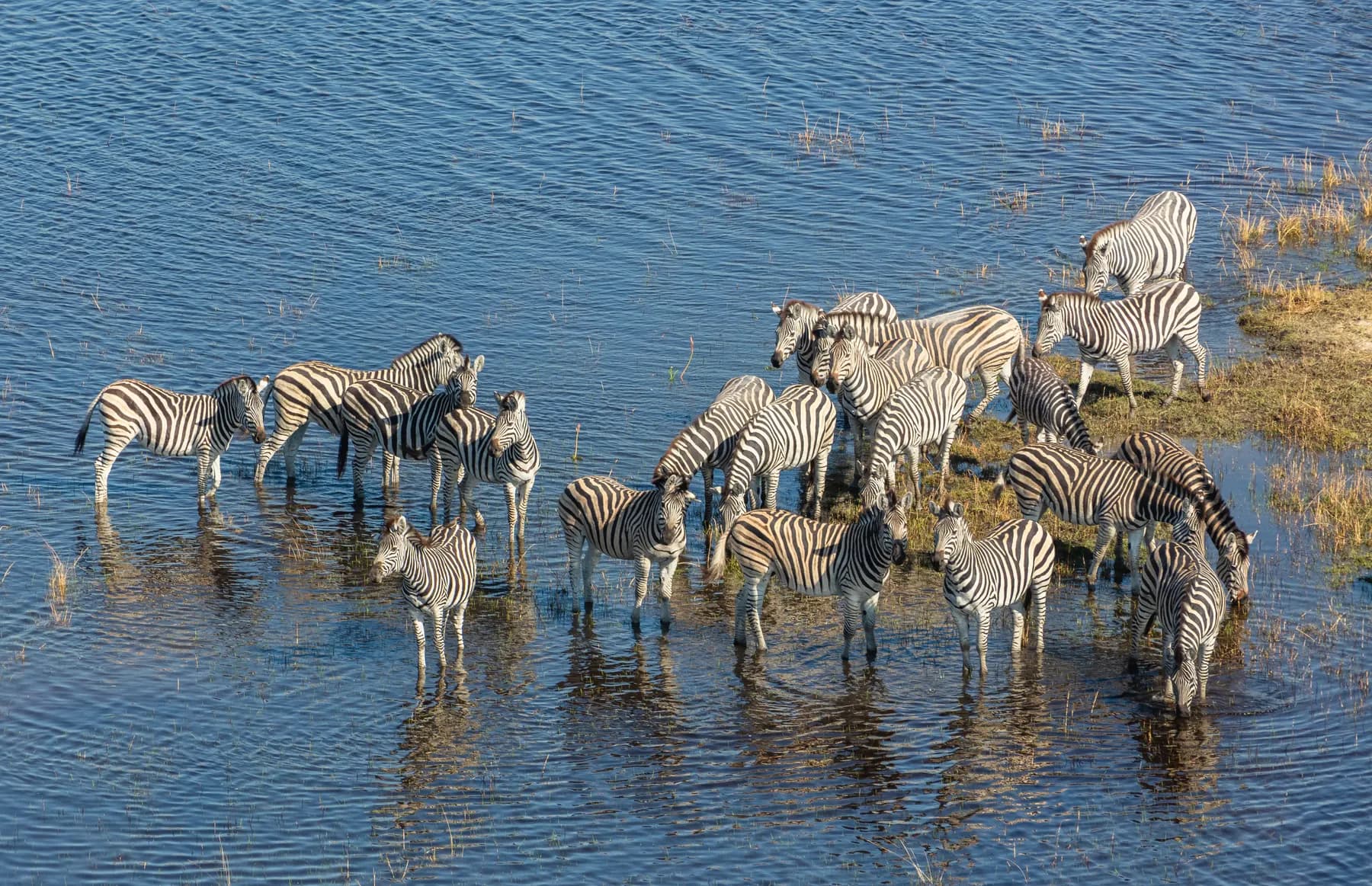
Then the rain falls, and everything changes. The pans are covered in a film of water, grass grows on their edges, and one of the largest zebra populations in Africa leaves the Boteti River for the grasslands of Ntwetwe pan, followed by wildebeest and lions. On Sua pan, tens of thousands of greater flamingos come to nest: one of only two breeding colonies of flamingos in southern Africa, fragile, disturbed by quad bikes and vehicles that come too close.
Between the two seasons live the meerkats, in groups habituated to people, which climb onto the shoulders of seated visitors to watch the horizon better. And a genetic study in 2019 proposed that this region, when it was a land of lakes and marshes, was the cradle of the first modern humans, two hundred thousand years ago: a debated hypothesis, but one that gives the salt another depth.
Kubu, Baines and the baobabs
On the edge of Sua pan, an island of granite rises from the salt: Kubu. Its grey rocks are covered in twisted baobabs, some several centuries old, and a white line of fossil guano marks the old level of the lake. The place is a national monument and held sacred by the neighbouring communities; you camp there in total bareness, on a site run for the benefit of the village, and watch the sun set over a sea of salt.
Further north, in Nxai Pan National Park, a cluster of isolated baobabs bears the name of the painter Thomas Baines, who depicted them in 1862 during his journey with the explorer James Chapman. They have barely changed since the canvas: you can hold it up in front of them and count the branches.
The baobab is the landmark of the Kalahari. In a landscape without relief it says where you are, where you slept, where the track runs. The San ate its fruit and drank the water stored in its trunk; today’s travellers photograph it at dawn, then move on, because there is nothing else to do at Kubu but look, and that is enough.
The San, first inhabitants
The Kalahari has been inhabited for longer than almost any other region of the world. The San, long called Bushmen, are its first known inhabitants: hunter-gatherers whose cultures are the oldest in southern Africa and whose click languages resemble no others. Botswana today counts some 63,000 of them, the highest proportion of any country in the region.
Their knowledge is the desert’s: reading tracks in the sand, finding water in roots and melons, storing the rainy season’s water in buried ostrich eggshells, hunting with bows and poisoned arrows. You discover it on walks with San guides, out of Ghanzi, the ‘capital of the Kalahari’, or from the villages of the centre, where artists’ cooperatives sell prints and paintings. These encounters happen on their terms, not as a show.
Recent history is painful. The San of the Central Kalahari reserve were relocated by the state from 1997; Botswana’s High Court ruled the evictions unlawful in 2006, and the return remains partial and difficult. Their memory, though, is written in the rock: at Tsodilo, in the far north-west, four hills carry more than 4,500 rock paintings, rhinos, elands, giraffes, dancers, which earned the site its World Heritage inscription in 2001 and its nickname, the Louvre of the Desert.
At the desert’s edge, the Okavango
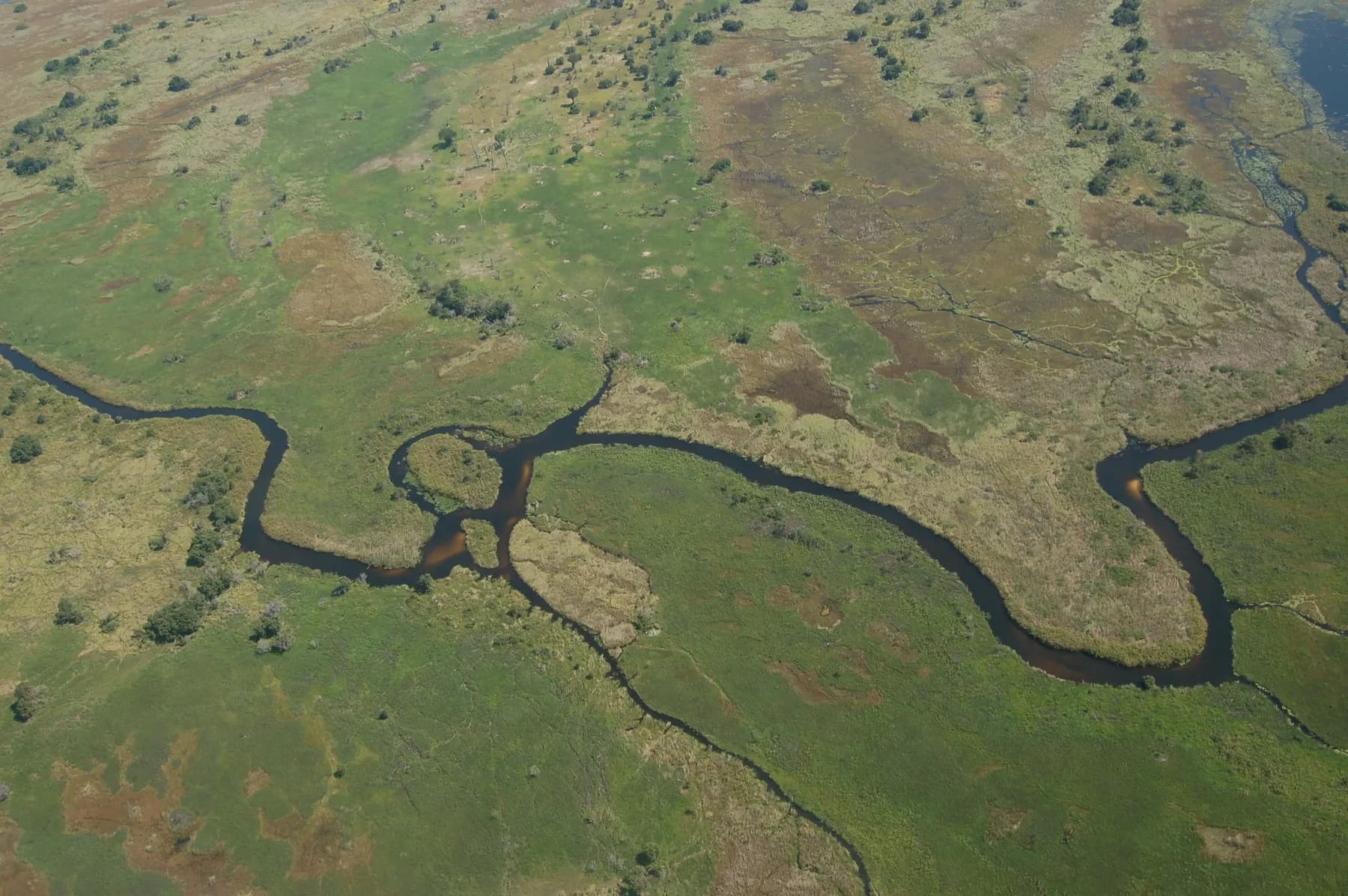
The paradox of the Kalahari lies at its northern edge: a river, the Okavango, comes down from Angola, enters the sand and never leaves it. It spreads into an inland delta of 6,000 to 15,000 square kilometres depending on the season, eleven cubic kilometres of water a year that evaporate or seep away almost entirely, without ever reaching the sea. The old shorelines of Lake Makgadikgadi hold it back.
The flood arrives out of step: water that fell in Angola during the summer takes months to come down and floods the delta in the heart of the dry season, between June and August, when the rest of the Kalahari is thirsty. Animals then gather there in their tens of thousands, and you glide between the papyrus in a mokoro, the pole-pushed dugout, at hippo height.
In 2014 the delta became the thousandth site inscribed on the World Heritage List. It is the reason most travellers come to Botswana; the Kalahari is the reason they come back.
Getting there, and when
Maun, on the edge of the delta, is the gateway to the north and centre, with its airport and its agencies; Gaborone, the capital, serves Kgalagadi from the south. Botswana has chosen low-volume, high-cost tourism: few beds, immense parks and camps booked long in advance. Independent travellers set off in equipped 4x4s with fuel, water and food for several days and, in the Central Kalahari as on the pans, preferably in two vehicles.
Seasons are chosen by place: December to April for the life of the Central Kalahari and the zebras of Makgadikgadi, May to October to drive on the dry pans, see the delta in flood and enjoy the cold, clear nights of Kgalagadi. Winter days are mild, nights drop below freezing; summer days pass 40 degrees.
In the villages you eat seswaa, beef boiled for hours then pounded, served with bogobe, the sorghum porridge, and morogo, cooked green leaves; in season, phane, dried mopane caterpillars, and Kalahari truffles, gathered after the rains. Our Botswana guide carries the entry rules, health and official advice, as well as the rules of the parks.
Sources · 11
Live this journey.
Guided tours, excursions and tickets from our partner, in a new tab. Prices and availability are theirs.
The journal
Keep reading.
Rwanda, gorillas and lakes
The mountain gorillas of the Virungas, a crater lake, Lake Kivu and its trail, Nyungwe forest and the Akagera savannah: Rwanda told stage by stage, from the sources.
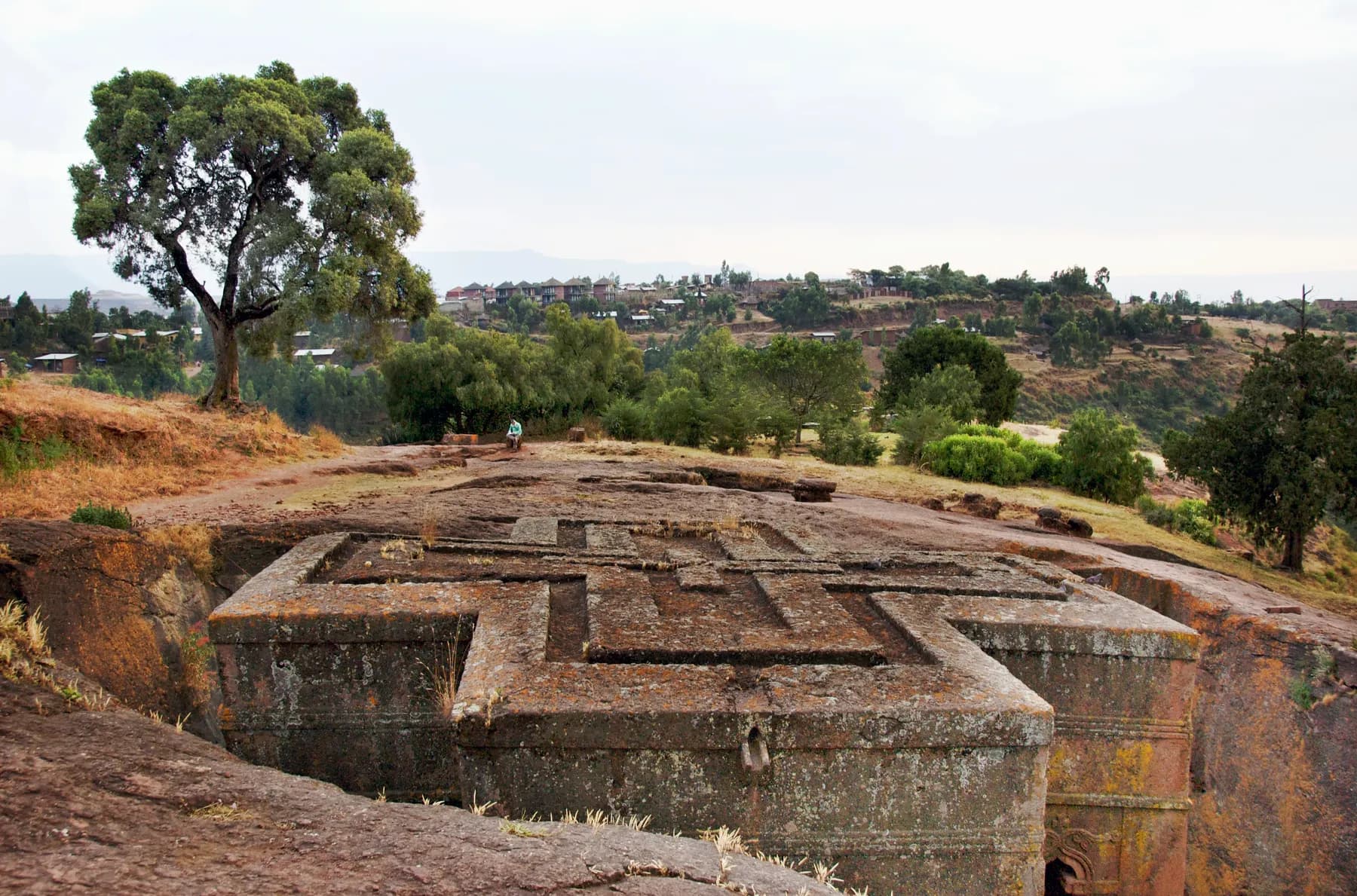
Lalibela, the town carved towards the sky
Eleven churches cut into living rock, a king who wanted his own Jerusalem, pilgrims in white at dawn: a notebook at 2,500 metres.
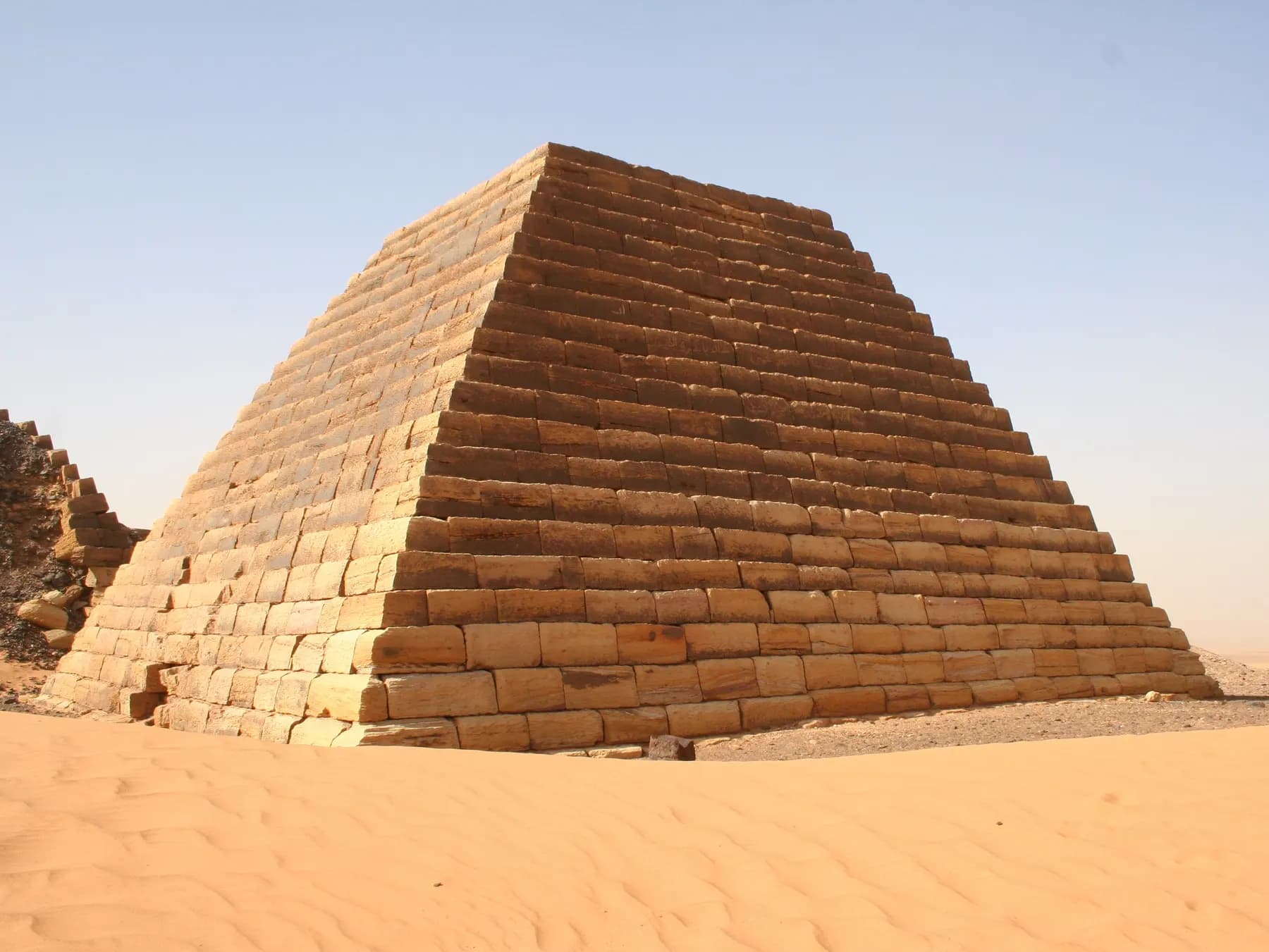
Meroë, the pyramids of the other Nile
Two hundred pyramids in the Sudanese sand, a kingdom that stood up to Rome, warrior queens and a treasure hunter: the Kush notebook.