The Comoros, islands of the Moon and of perfume
A living volcano, a medina facing the Mozambique Channel, a marine park invented by ten villages and the scent of ylang-ylang: three islands almost nobody visits.
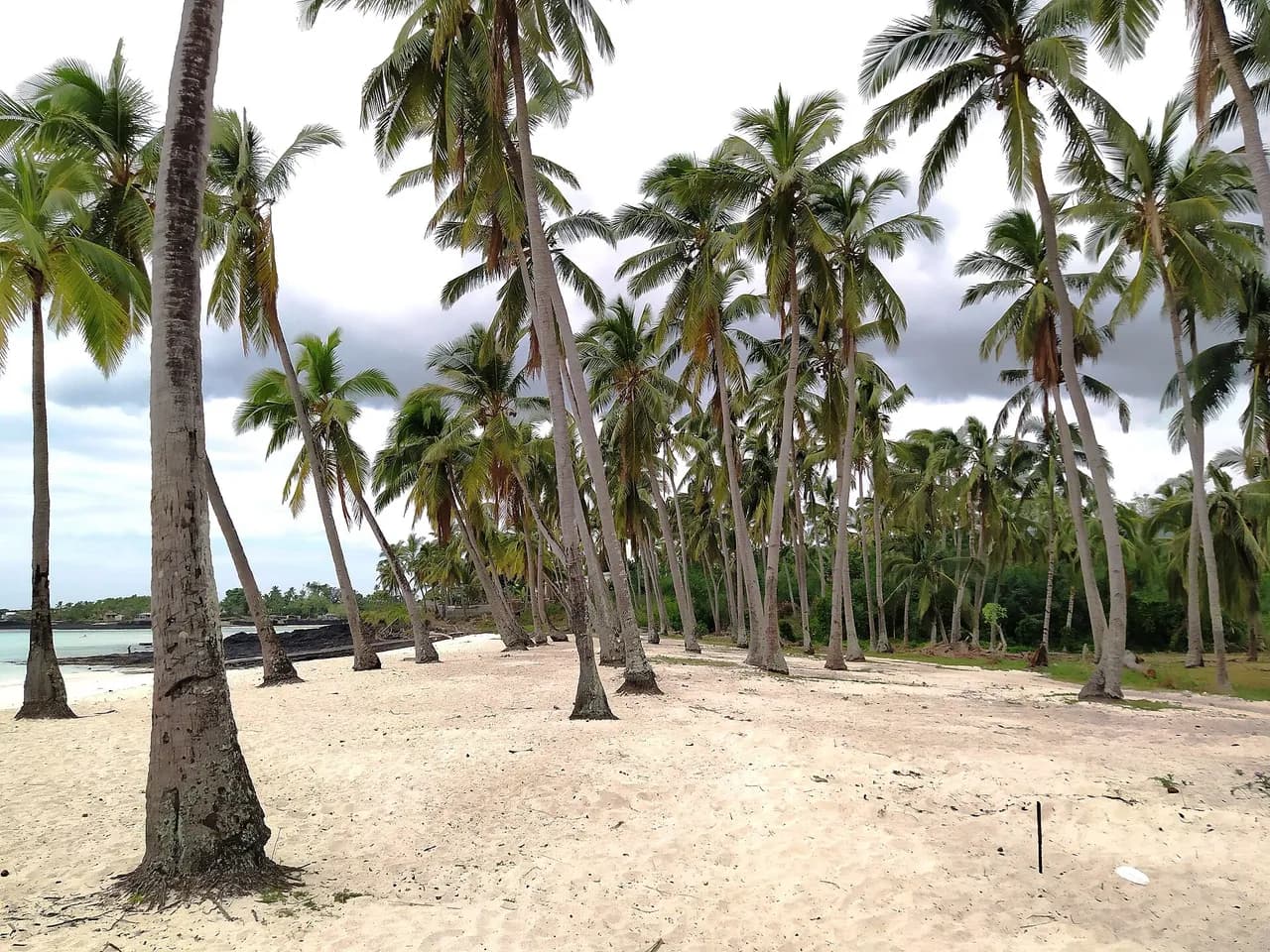
You usually land at night, and the first thing the Comoros give you is not an image but a smell: ylang-ylang, sweet, heady, drifting into the plane as soon as the door opens. Then, in the morning, the setting: a coast of black lava bitten by a turquoise sea, coconut palms, villages of whitewashed coral stone, and above everything, hidden in cloud, Karthala, one of the most active volcanoes in the world.
Three islands make up the Union of the Comoros, at the northern entrance of the Mozambique Channel: Grande Comore, Anjouan and Mohéli, each with its own character, its capital, its beaches and its sultans of old. This notebook takes them one by one, from the volcano to the turtles, along with what makes Comorian life: the great wedding, twarab music and a vanilla lobster.
Three islands and a volcano
The Comoros are volcanoes risen from the sea, one after another, from east to west: Mayotte, the oldest, today a French department claimed by the Union; Anjouan and Mohéli, worn by erosion, green and jagged; and Grande Comore, the youngest, still under construction, where the lava of 2005 and 2006 ran to within a few kilometres of the villages.
The country is small, 1,659 square kilometres in all, and one of the most densely populated on the continent. Villages almost touch along the coasts; the interior climbs quickly to forest and ridges. Independent since 6 July 1975, the Comoros speak Shikomori, a Bantu language fed by Arabic and Swahili, as well as French and Arabic.
The sea is everywhere, and it is not just scenery. It brought the Arab sailors who named the archipelago the ‘islands of the Moon’, the Swahili, the Malagasy, the Portuguese; it gives fish, dhows and, off the south-west coast of Grande Comore, one of the strangest animals on the planet, the coelacanth.
Moroni, the medina facing the sea
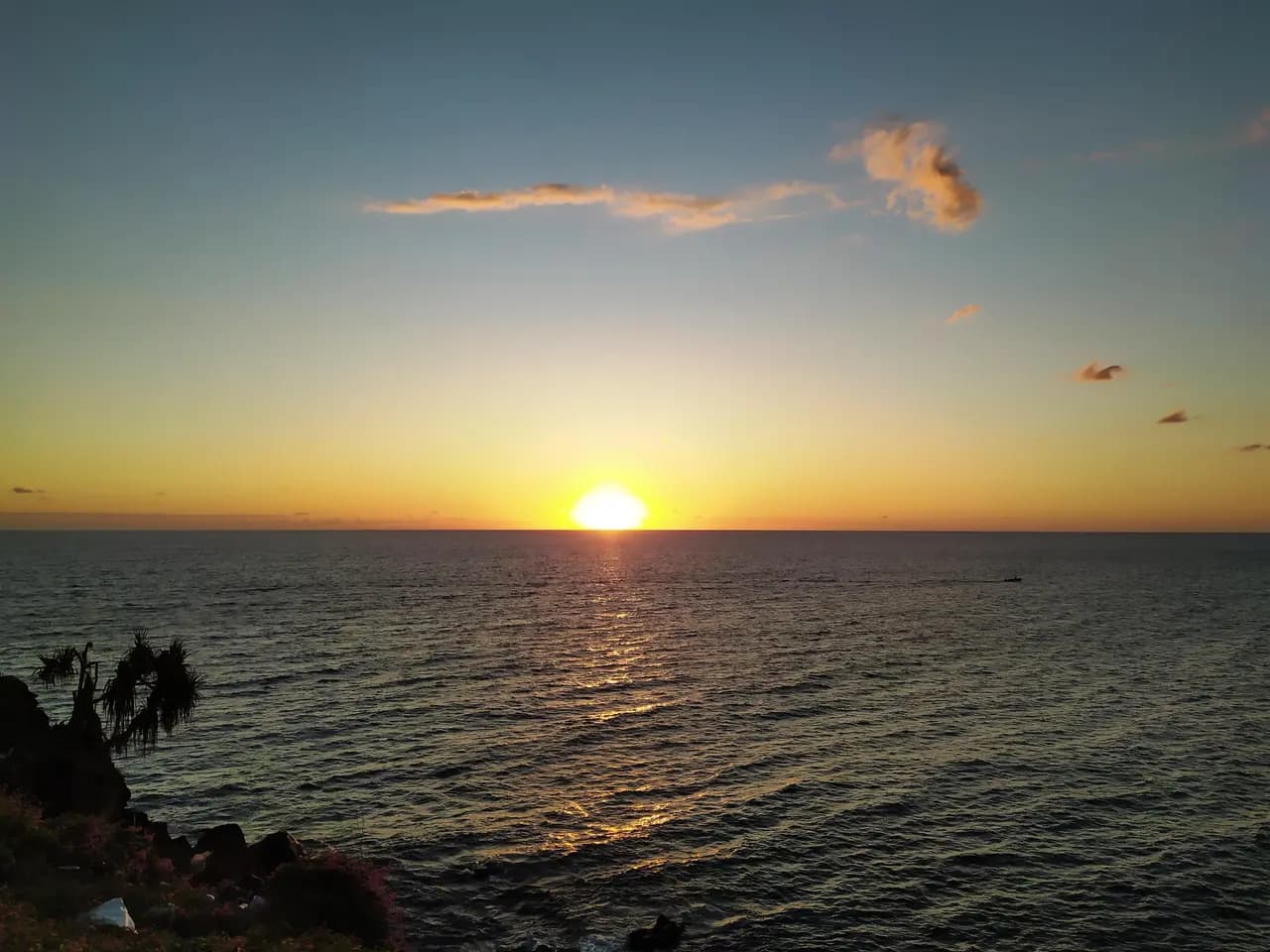
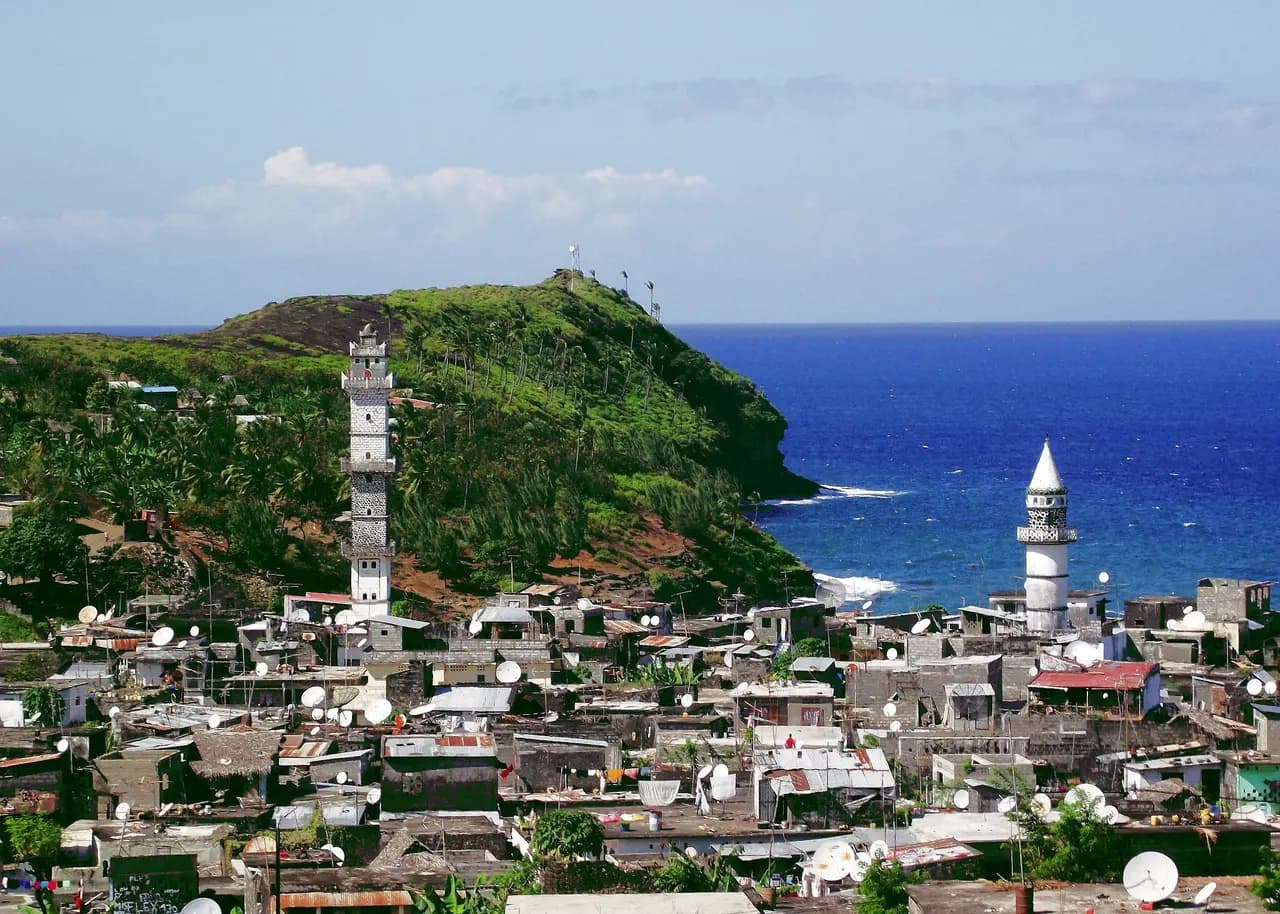
Moroni, the capital, fits into a few streets between the volcano and the water. The old port is a stone cove where dhows settle onto the sand at low tide; above it, the Friday mosque, Badjanani, white with arcades, is the image of the town, especially at sunset when the light comes off the sea. Behind lies the medina: crooked alleys, carved doors, stairways, courtyards where washing dries.
Women wear the shiromani, a large printed cloth draped over head and body, and many keep on their faces the msindzano, a pale yellow beauty mask made of sandalwood ground on a coral stone, which protects from the sun. On Fridays the men come out in embroidered kofia caps and white robes. Greetings are long; nobody is hurried.
North of the town, Itsandra beach belongs to Moroni’s families, with its pirogues and football games at dusk. At the national centre for documentation and scientific research you can see preserved coelacanths, the fleshy-finned fish believed to have vanished with the dinosaurs until one was caught off South Africa in 1938, and a second, in 1952 off Anjouan, revealed that the Comoros were their home. The fishermen call them gombessa.
Climbing Karthala
Karthala takes up two thirds of Grande Comore. It is a shield volcano of 2,361 metres that has erupted more than twenty times since the 19th century, and its summit caldera, three kilometres by four, is among the largest of any active volcano on Earth. The eruptions of April 2005 and May 2006 covered the villages in ash; since then it has slept, watched by an observatory.
You climb it in two days from the villages on the heights, with a guide and a porter, first crossing banana and vanilla plantations, then the humid forest where the island’s endemic birds live, then heather, then nothing: a desert of black and red cinders up to the rim of the caldera. You sleep there in a tent, in cold and wind, to see at dawn the crater steaming and the sea all around, on both sides of the island.
It is not a technical climb, but a long walk with a steep ascent and, above all, a descent over sliding ash. Few visitors do it; those who do talk about it for a long time.
Mohéli, the island that invented its own park
Mohéli is the smallest and least populated of the three, with its capital Fomboni and a southern coast fringed with islets. It was here, in April 2001, that the country’s first protected area was born, the Mohéli Marine Park, and it was born in a rare way: the ten villages along its shore negotiated the rules of fishing and protection with the state, then enforced them themselves. It became a national park in 2010 and was extended in 2015 to three quarters of the island’s land.
On Itsamia beach, in the east, green turtles come to nest in numbers, and the villagers organise their protection and the welcome of visitors: you walk the sand at night without a torch to watch a female dig her nest. Off Nioumachoua, the islets are ringed by reefs where dolphins swim, and from July to October humpback whales calve in the channel.
In the forest of the heights lives Livingstone’s fruit bat, one of the largest and rarest bats in the world, found only on Mohéli and Anjouan: some twelve hundred individuals at the last serious count, hanging in colonies in the tall trees. Mohéli is the island for people who like to walk, dive and sleep in bungalows at the water’s edge, and it has nothing else to offer, which is a great deal.
Anjouan, the island of perfumes
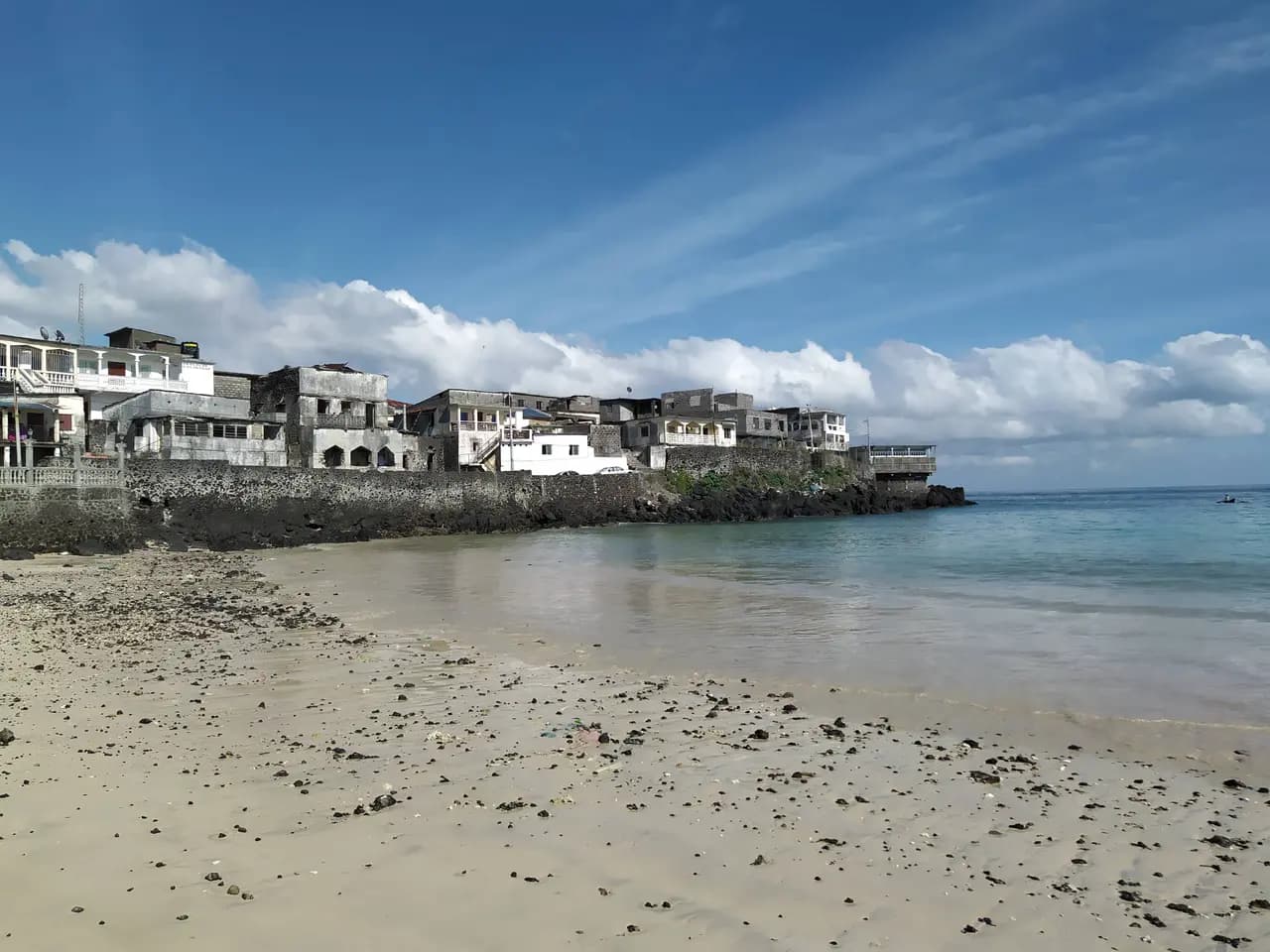
Anjouan is the steepest: 424 square kilometres of slopes rising to Mount Ntringui at close to 1,600 metres, terraced to the point of vertigo. Its capital, Mutsamudu, has the finest medina in the archipelago, a maze of alleys beneath an 18th-century citadel, and its port is the busiest in the country. Domoni, on the east coast, was the capital of the sultans.
But Anjouan is smelled before it is seen. Along the roads, cloves dry on mats, vanilla hangs in drying sheds, and in the ylang-ylang distilleries, wood-fired copper stills turn sacks of yellow flowers into a few litres of essential oil. The Comoros are the world’s leading producer: most great perfumes hold a drop of these hills.
Cloves are today the country’s first export, with vanilla and ylang-ylang behind them, and world prices make or break the years. In the villages, a distillery door will be opened for you without an appointment; you need only ask, and accept the ginger tea.
The great wedding
Nothing explains the Comoros better than the anda, the great wedding. It is not a wedding party: it is an institution. A man who celebrates it, often past forty, after years of saving and with the help of his whole family, rises to the rank of notable: he may sit and speak on the village square, the bangwe, wear the elders’ shawl, be buried with honour. The festivities last several days, sometimes weeks, and mobilise the whole village.
People dance and sing twarab, the music of the islands, cousin of Zanzibar’s taarab, with violins, oud, accordion and women’s choirs; meals are served to hundreds of guests; gold is given. The diaspora, large in Marseille, plays a central role: a great share of the country’s remittances goes to fund these celebrations, and the summer months see those who live abroad come home.
It is also when Comorian cooking comes into its own: spiced rice pilau, mataba, pounded cassava leaves cooked in coconut milk, mabawa, chicken wings grilled with chilli, fish in coconut and, on great occasions, vanilla lobster, the most famous dish of the islands, where the pod perfumes a sauce of butter and lime. A visitor invited to a great wedding does not refuse.
Beaches, boats and the right moment
Grande Comore has its beaches in the north: Mitsamiouli, with its white sands and hotels, the Trou du Prophète, a cove framed by lava, and the Lac Salé, a crater filled with green water set at the sea’s edge. On the east coast, Chomoni alternates white sand and black rocks. Everywhere the sea is warm, and the reefs begin a few strokes from the shore.
You cross between islands by small plane or by boat. The boat is cheaper and less certain: the channel gets up quickly, and crossings are decided by the weather. From abroad you arrive at Moroni-Hahaya airport, generally via Addis Ababa, Nairobi, Dar es Salaam or Réunion.
The dry season, from May to October, is the one to choose: cool trade winds, calmer sea, whales. From November to April it is hot and humid, the rains are heavy and cyclones can pass. Our Comoros guide carries the entry rules, health and official advice; this notebook keeps only one thing to pack: time, because nothing here moves fast, and that is exactly right.
Sources · 10
Live this journey.
Guided tours, excursions and tickets from our partner, in a new tab. Prices and availability are theirs.
The journal
Keep reading.
The Bijagós, an archipelago that lives by its own rules
Eighty-eight islands off Guinea-Bissau, hippos that swim in the sea, turtles by the thousand and a society that held off the Portuguese until 1930.
Cabo Verde, island by island
The first European town in the tropics, a lived-in volcano, the country’s smallest island, its cultural capital, mountain trails and white-sand beaches: Cabo Verde told island by island, from the sources.
Lalibela, the town carved towards the sky
Eleven churches cut into living rock, a king who wanted his own Jerusalem, pilgrims in white at dawn: a notebook at 2,500 metres.