Astronomy is full of learned names made of letters and numbers. And then there is Inkathazo. The word means “trouble” in isiZulu and isiXhosa, and the team at the University of Cape Town (UCT) did not pick it by chance. Announced on 24 January 2025, this galaxy refuses to fit in the boxes. It is too big for where it sits, bent where it should be straight, and more energetic than the models predict.
Trouble, then. The kind of trouble scientists love.
Thirty-two Milky Ways end to end
First, take the measure of the thing. Inkathazo is a giant radio galaxy. To the eye, or rather through an optical telescope, a galaxy of this type is nothing special. Everything changes when you listen at radio wavelengths: two colossal jets of plasma burst out on either side of its centre.
Inkathazo’s jets span 3.3 million light years. The University of Cape Town offers a comparison that helps picture the unimaginable: more than 32 times the size of our Milky Way. Our entire galaxy, with its billions of stars, would fill only a small fraction of this structure.
One patch of sky, three giants
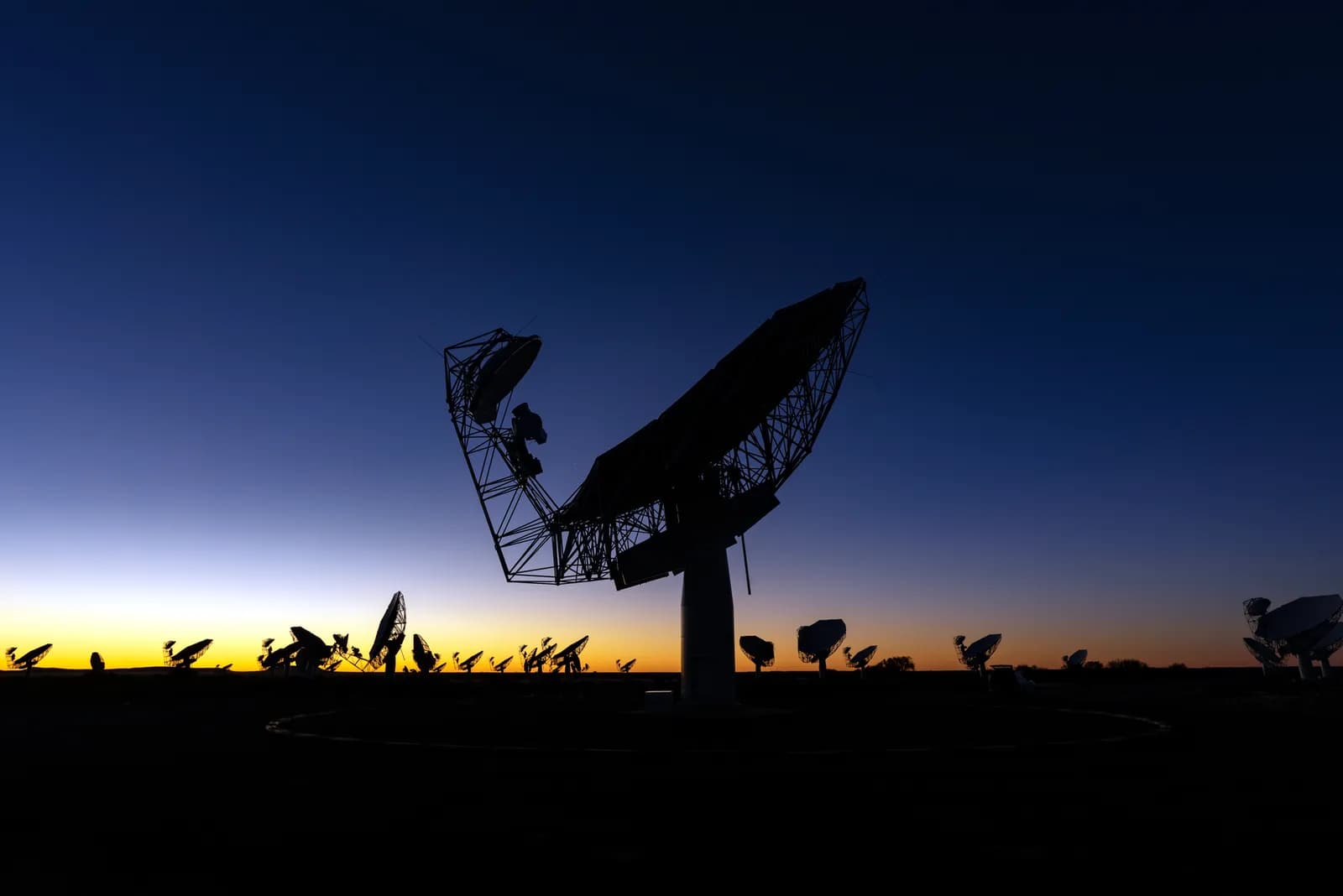
The instrument that made the discovery possible stands in South Africa. MeerKAT, run by the South African Radio Astronomy Observatory (SARAO), has 64 dishes and is a precursor to the future Square Kilometre Array, the large international radio astronomy project.
Yet the team did not sweep the whole sky. It pointed MeerKAT at a single small patch. There it found not one but three giant radio galaxies. The kind of result that makes you look up from your screen. Because if such a small corner of sky holds three, what is the rest hiding? Dr Jacinta Delhaize, a researcher in UCT’s Department of Astronomy, sees in it the promise of “a huge treasure trove of undiscovered GRGs in the southern sky”.
Why it is trouble
Inkathazo earns its name for three reasons. The first jumps out from the images: one of its jets is bent instead of running straight. “It doesn’t have the same characteristics as many other giant radio galaxies,” says Kathleen Charlton, a UCT master’s student and co-author of the study, who describes “an unusual shape”.
The second is its address. Astronomers expected these giants to form mostly in sparse regions of the Universe. Inkathazo lives inside a cluster of galaxies.
The third is the subtlest. Thanks to spectral age maps made with MeerKAT, the researchers spotted unexpected boosts of energy in the jets’ electrons. The likely cause: collisions with the hot gas that fills the space between the galaxies of the cluster. According to the university, the result challenges current models of plasma physics. In other words, what we thought we knew about these jets needs another look.
Science made here
The work appeared in the Monthly Notices of the Royal Astronomical Society, one of the field’s major journals. It brings together researchers from several countries around the Cape Town team, including Kshitij Thorat of the University of Pretoria, according to the Inter-University Institute for Data Intensive Astronomy (IDIA).
But the finest part of this story may be what it says about science on the continent. An instrument built in South Africa. A master’s student among the authors. A name taken from two South African languages, now written into the world’s astronomical literature. Africa no longer just offers its sky: it observes it, analyses it and publishes.
There is also a small lesson in method in this name. Science does not move forward only when everything is confirmed: it moves forward when something resists. To christen a galaxy “trouble” is to say so with humour, and with a certain pride. Few objects in the sky can claim a name that sums up their scientific importance so neatly.
And the archives still have things to say. In March 2025, the Daily Maverick described South African researchers combing through six years of MeerKAT data to check that nothing had escaped them.
The “trouble” is not solved. How do such jets stay powered over such distances? How many giants are still waiting in the southern sky? It will take more nights of observation to tell. That is exactly what makes Inkathazo such a joy: it gives no answer, it opens a building site.
Sources
- MeerKAT helps UCT scientists uncover giant radio galaxy · University of Cape Town News, 24 January 2025
- Giant radio galaxy could hold 30 Milky Ways, astronomers say · ScienceAlert
- UCT and IDIA researchers find giant radio galaxy Inkathazo · IDIA (Inter-University Institute for Data Intensive Astronomy)
- The RATT, the PARROT and the MeerKAT: SA scientists unlocking secrets of the stars · Daily Maverick, 9 March 2025
- South African telescope discovers a galaxy · Stuff (South Africa), 27 January 2025